
So, you want to reduce time to hire? Let's be clear: the secret isn’t some magic bullet. It’s about killing the dozens of tiny, frustrating delays that sabotage your momentum. It's time to ditch the reactive "post and pray" approach and build an aggressive, proactive system that treats candidates like valued customers, not just names on a spreadsheet.
Let's be real. Your hiring process probably feels like it’s held together with duct tape and wishful thinking. Weeks bleed into months, your best candidates take other offers, and you're left scratching your head, wondering what went wrong.
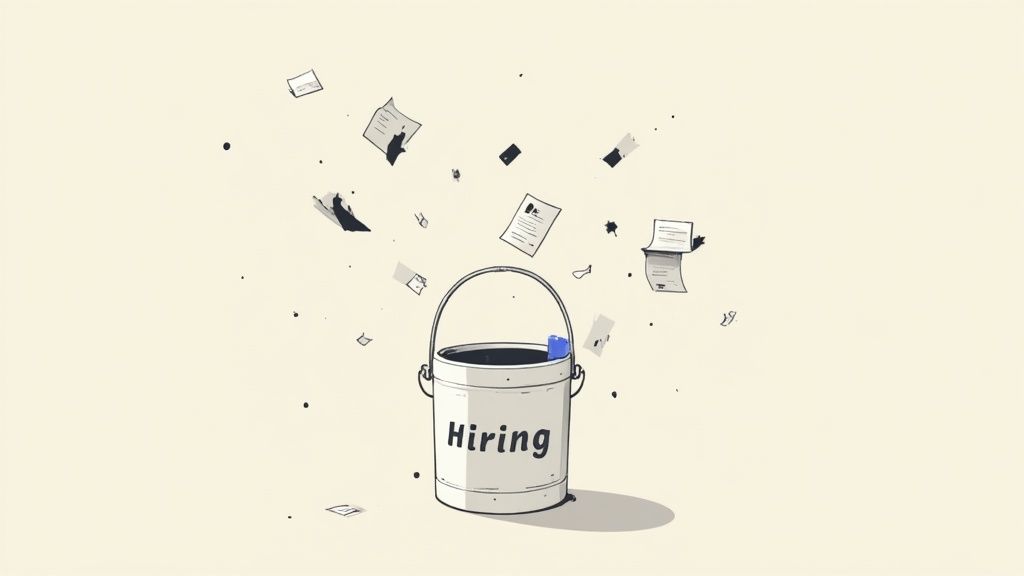
It’s a classic leaky bucket scenario. You pour great candidates in at the top, but they slip through the cracks before you can even think about an offer.
Honestly, that "global median time to hire" stat is a vanity metric. What really matters is whether your process is slower than your competitors'. While the average time to fill a role can drag on for 42 days, the real winners are closing candidates in under 20. Anything longer, and you're just warming up talent for the company that moves faster.
These delays aren't just frustrating; they come with serious costs that ripple across the business. From lost productivity to a damaged reputation, a slow hiring cycle hurts much more than you think.
| Bottleneck | Direct Cost (Lost Revenue, Recruiter Time) | Hidden Cost (Team Morale, Damaged Employer Brand) |
|---|---|---|
| Vague Job Descriptions | Wasted hours screening irrelevant candidates; ad spend on the wrong audience. | Frustrates top talent who can't tell if the role is a fit; attracts unqualified applicants. |
| Scheduling Nightmares | Dozens of emails and follow-ups per candidate, eating up recruiter and manager time. | Signals disorganization to candidates; creates a poor candidate experience. |
| "Hiring by Committee" | Endless interview loops and delayed feedback cycles extend the process by weeks. | Top candidates accept other offers; existing team members get burned out from interviewing. |
| Delayed Offers | The best candidate gets poached by a faster-moving competitor. | Damages your employer brand when candidates share their negative experience online. |
Each bottleneck adds up, creating a death-by-a-thousand-cuts scenario that slowly bleeds your talent pool dry and leaves your teams overworked and understaffed.
So, where are the leaks? After years of trial and (lots of) error, I’ve found they usually hide in plain sight. These aren't minor hiccups; they're gaping holes costing you talent, time, and money.
When you're streamlining your recruitment process for faster hiring success, you'll often find these usual suspects are to blame:
You can’t just patch these holes one by one. You need a better bucket. This means shifting from a slow, reactive approach to an always-on system that anticipates your needs. The first step? Recognizing that you can't start sourcing from scratch every time a role opens. A truly proactive strategy starts with understanding how to build a talent pipeline so you have qualified, engaged candidates ready to go. This isn't just about speed; it's about fundamentally rethinking how you make one of the most important decisions in your business.
We’ve all seen it. The job description that reads like a wish list for a superhero, not a software engineer. Ten years of experience in a technology that’s only existed for five? Check. Fluent in four programming languages and a project management guru? Of course.
Turns out there’s more than one way to hire elite talent without mortgaging your office ping-pong table.
This is the hunt for the "purple squirrel"—the mythical candidate who perfectly checks every single box. It's also one of the biggest, most self-inflicted drags on your hiring speed.
Every stakeholder bolts on another "must-have," and soon you have a Frankenstein's monster of a job description. The result? Hope you enjoy spending your afternoons fact-checking résumés—because that’s now your full-time job.
This endless search for perfection is a fantastic way to slow down your hiring process. The best candidates aren't just sitting around, waiting for you to find a unicorn. They’re busy accepting offers from companies that know what actually matters.
We had to get ruthless about this. Our breakthrough came when we forced a clear distinction between what was truly essential for the job and what was just a "nice-to-have." It sounds simple, but it’s a painful exercise in prioritization that most teams conveniently skip.
The goal is to define the 3-4 core competencies for a role that are absolutely non-negotiable. These are the skills or attributes without which a person simply cannot do the job. Everything else? It’s noise. It’s gravy. It's a distraction that kills your momentum.
For an engineering role, it might look something like this:
This simple shift changes everything. Your sourcing becomes laser-focused. Your interviews stop meandering and start assessing what truly predicts success on the job. You’re no longer just resume-matching; you're looking for genuine capability.
The real magic is that this doesn't just speed up the process; it dramatically improves the quality of your hires. You stop overvaluing credentials and start valuing ability, which opens you up to a much wider, more diverse talent pool.
When the usual job boards aren't turning up candidates with these core competencies, you can't just wait around. Exploring more direct strategies for direct outreach to top talent becomes a powerful way to connect with specialized professionals who aren't actively looking but have the exact skills you need.
Stop letting the perfect be the enemy of the great. Define your non-negotiables, be ruthless about ignoring the rest, and you’ll find that "great" is more than good enough to build a world-class team. And you'll do it twice as fast.
If you’d told me ten years ago that one of a recruiter's biggest jobs would be playing calendar Tetris, I would have laughed you out of the room. But here we are. For most hiring teams, the single biggest time-sink is the administrative nightmare of interview scheduling.
Cancellations, reschedules, trying to find a 45-minute slot that works for a candidate and five different people on your team—it’s a recipe for delays. More importantly, it’s a great way to signal to your top candidate that your company is a disorganized mess. Get ready to spend your afternoons playing email tag, because that's what it takes.
This back-and-forth isn’t just an annoyance; it's a massive drain on company resources. Research shows that 35% of a recruiter's time is spent just on scheduling interviews. When you add that to the 45% of talent leaders who say they need more candidate touchpoints, you’ve got a perfect storm for a slow, painful process. (You can dig into more of these eye-opening hiring statistics from goodtime.io).
Ever thought about the real cost of a "quick" 30-minute screening call? You've got the recruiter's time, the hiring manager's time, and the candidate's time. By the time you factor in all the administrative overhead just to get it on the calendar, that simple chat can easily cost hundreds of dollars in lost productivity before anyone even says hello.
Now, multiply that by dozens of candidates across multiple open roles. You're not just wasting time—you're burning cash. This is the point where automation stops being a "nice-to-have" and becomes an absolute necessity. A simple scheduling link can eliminate 90% of the back-and-forth.
We’re not talking about replacing the human element. The goal is to remove the mindless friction that gets in the way of it. You want to spend more time talking to candidates, not talking about when to talk to them.
This process flow below shows exactly how a vague job description creates a messy candidate pool, which makes the scheduling headache even worse.
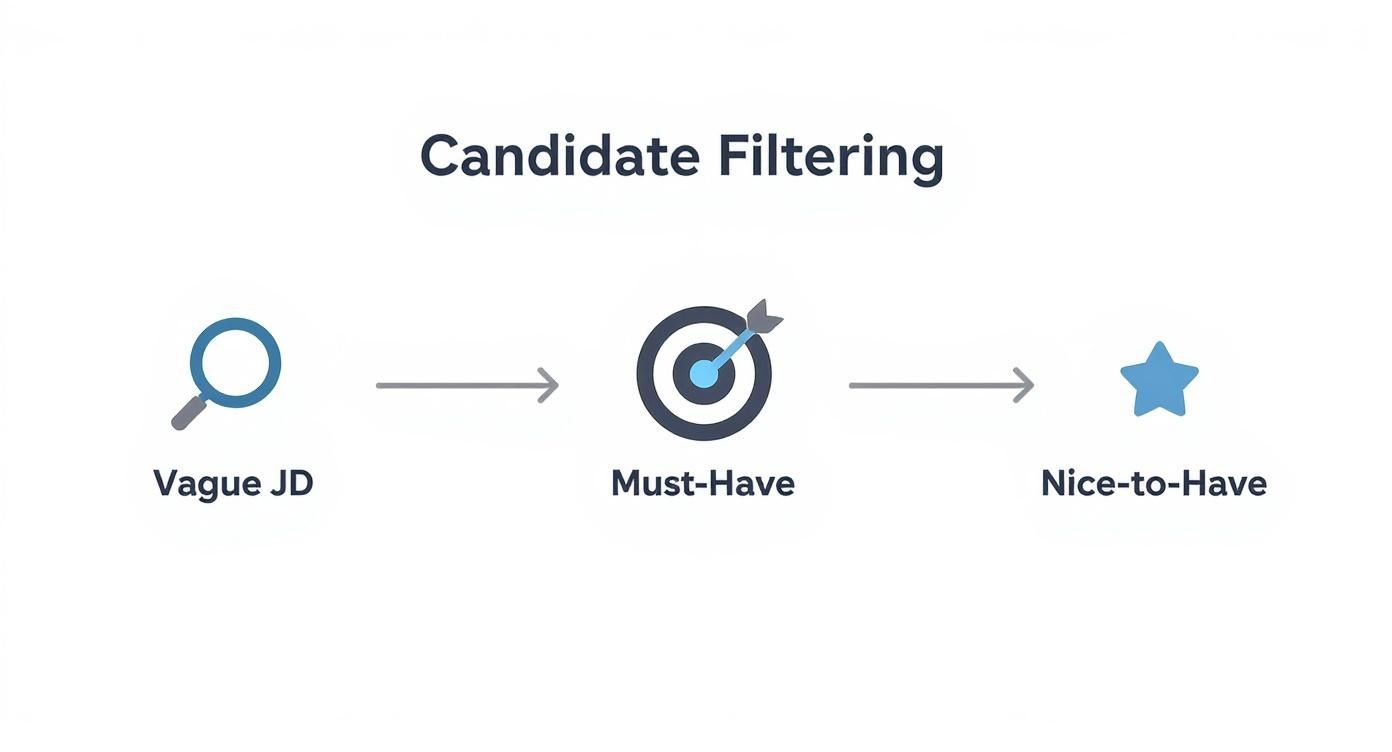
Starting with clear "must-have" criteria doesn't just improve candidate quality. It simplifies everything that comes after, especially scheduling.
Not all scheduling tools are created equal. I’ve tried my fair share, from the free-but-clunky options to enterprise-level platforms. The right choice really comes down to your hiring volume and how complex your interview loops are.
The key is to find a system that fits into your current workflow without causing more problems. A poorly chosen tool just creates another bottleneck. For a deeper look, check out our guide on the best recruitment automation software to find the right tool to help you escape the scheduling black hole for good.
Let’s be honest: the traditional interview is fundamentally broken. It’s often just a series of unstructured chats where interviewers trot out their favorite brain teasers or "gotcha" questions. The whole process is a terrible predictor of on-the-job performance and a colossal waste of everyone’s time.
If you enjoy spending your afternoons in back-to-back calls, then by all means, stick with a process built on vibes instead of evidence. But the "tell me about a time you faced a challenge" routine is more theatrical than practical. It rewards good storytellers, not necessarily good performers.
It's time to get serious about assessments. And no, I'm not talking about those cheesy personality quizzes that try to sort your candidates into Hogwarts houses.
I’m talking about short, practical work samples, structured technical challenges, or case studies that actually mirror the work someone will be doing. This isn't about adding another hoop to jump through—it’s about replacing a useless hoop with one that gives you a powerful, objective signal on a candidate's abilities.
Think about it: why spend an hour asking a developer to describe their coding style when you can give them a 45-minute challenge and see it for yourself?
For a content marketer, you might provide a short brief and ask them to outline a blog post. For a salesperson, it could be a mock email outreach to a fictional prospect. These aren't final exams; they're insightful previews of their real-world skills.
This shift does more than just reduce time to hire—it forces you to define what success in the role actually looks like. You can't design a good assessment without first clarifying the core competencies, which sharpens your entire hiring focus.
The secret is to make your assessments respectful of the candidate’s time and directly relevant to the role. A massive, weekend-long project is a huge red flag for candidates. A focused, 60-90 minute asynchronous task, on the other hand, signals a professional, organized company.
Here’s what works:
Implementing practical evaluations is a cornerstone of effective pre-employment skills testing, helping you filter candidates based on tangible ability, not just how well they talk. This is about finding people who will truly excel, not just those who say they can do the job. You'll end up making better, data-driven decisions that pay dividends long after the hire is made.
Does your final interview stage feel more like a congressional hearing than a conversation? If you have more than three people making the final call, you’re probably moving too slow. I’ve been there—inviting every stakeholder I could think of, believing that more opinions would lead to a better, safer decision.
It doesn’t. It just creates analysis paralysis.
“Hiring by committee” is where speed and conviction go to die. Every extra person you add to the interview loop makes scheduling a nightmare. Just try finding an open slot on six busy calendars. On top of that, each new interviewer brings their own set of personal biases and pet questions, muddying the waters and leading to a lukewarm “maybe” instead of a confident yes or no.
This isn't just an internal headache. In a market where a staggering 76% of employers report trouble filling open roles, speed is your biggest competitive advantage. We're in the middle of an ongoing global talent shortage, meaning you're not just competing for talent—you're racing against the clock. The best candidates often have multiple offers, and the company that acts decisively is the one that wins. You can dig deeper into how this skills gap is reshaping business in this 2025 hiring reality check from SocialTalent.
The solution is simple, but it demands discipline: define clear roles for your interviewers and trust them to do their part. A small, empowered panel is the secret to slashing your time-to-hire. Instead of a free-for-all where everyone asks the same things, assign a specific focus to each person.
Here’s what a lean, effective panel should look like:
That's it. Three people, three distinct perspectives. This structure stops you from asking the same questions five times and forces a clear, accountable decision. It’s all about learning to trust your team's judgment and moving with the urgency that top candidates expect and deserve. Stop the endless debates and start making confident hires.
You’ve finally found them. The one. They aced the assessment, charmed the team, and you’re ready to pull the trigger. Congratulations—you’ve officially entered the most dangerous phase of the entire hiring process.
This is the moment you win or lose the game. A slow, bureaucratic offer process is the fastest way to snatch defeat from the jaws of victory. The best talent gets snapped up in days, not weeks. While your team is stuck in approval chains, your perfect candidate is signing an offer with the competitor who moved faster.

Waiting until the final stage to discuss compensation is an amateur move. It’s a recipe for painful negotiations or, even worse, a flat-out rejection after you’ve invested weeks of everyone’s time.
The conversation about salary, equity, and benefits needs to start early and be transparent. Not in a weird, aggressive way, but as a simple alignment check. A quick, "Hey, just to make sure we're on the same page, the budget for this role is in the X to Y range. Does that align with your expectations?" on the very first call saves everyone a world of pain.
This isn't about lowballing; it’s about respecting their time and yours. If there’s a massive gap, it’s better to know on day one than on day thirty.
Don’t treat the offer stage like a dramatic reveal. Pre-close your candidate at every step. By the time you present the formal offer, it should be a formality—not a surprise party where no one knows what the gift is.
To truly reduce time to hire, your internal process needs to be faster than your candidate’s decision-making timeline. Here’s how you do it:
Work with finance to get a salary band approved before the final interview. The hiring manager must have the authority to make an offer within that range the moment they’ve made a decision. No "let me check with my boss's boss."
Have the offer letter template ready to go. The only thing left to do should be plugging in the final numbers and the candidate's name. It should take minutes, not days.
Always call them. A verbal offer is personal. It lets you gauge their reaction, answer immediate questions, and show genuine excitement. Follow up with the official document within the hour.
This isn’t about rushing. It’s about being prepared, decisive, and showing your top choice that they are, in fact, your top priority.
Let's cut to the chase and tackle the questions that inevitably come up when founders realize their hiring process is stuck in first gear.
Not if you’re getting faster by being more efficient, not by cutting corners. This isn't about skipping due diligence. It's about eliminating the administrative quicksand and endless, indecisive panel interviews that kill momentum.
A slow process isn't a better process—it's usually just a disorganized one. When you swap fluffy, unstructured chats for sharp, practical assessments, you actually improve your decision-making quality while you reduce time to hire. The goal is to replace wasted time with meaningful evaluation.
Speak their language. Frame it as a solution to their biggest headaches. They're overworked because critical roles are sitting empty. They're frustrated because they lose their best candidates to competitors who move faster.
Don't position this as some HR-led initiative. Show them it's about solving their problems. Present the data: how many hours they personally burn on repetitive interviews and scheduling chaos. A smarter, faster process isn't a shortcut; it's a strategic weapon to help them build the teams they desperately need.
Get an automated scheduling tool. Yesterday. It is, without a doubt, the single highest-leverage, lowest-effort change you can make.
It instantly vaporizes days of pointless back-and-forth emails for every candidate, dramatically improves the candidate experience, and frees up your team to focus on things that actually matter—like finding and closing top talent.

