So, you need to build some software. You can either hire your own developers or bring in an outside team. That second option is what the suits call IT outsourcing development. It’s sold as a magic wand that gives you access to a global talent pool and cuts costs. And it can be. But its success hinges entirely on picking the right partner—and not screwing it up.
Building a great product is hard. Building a great in-house tech team to do it? It's a special kind of hell, especially when you’re trying to move faster than your cash is burning.
You're usually stuck between two awful choices: either mortgage your office ping-pong table to afford local senior talent, or spend your days sifting through a mountain of résumés from "full-stack ninjas" who can't FizzBuzz their way out of a paper bag. Hope you enjoy spending your afternoons fact-checking resumes and running technical interviews—because that’s now your full-time job.
But what if there's a third way? A smarter path that lets you tap into elite engineering talent without the soul-crushing overhead of traditional hiring.
Let’s get brutally honest. A bad tech hire isn’t just a salary down the drain—it’s a cascading disaster. It costs you time, slows your momentum, and absolutely tanks team morale.
A study from the U.S. Department of Labor estimates the cost of a bad hire can hit up to 30% of that employee's first-year earnings. For a senior developer, that’s a mistake that can easily set you back $50,000. Ouch.
This is usually where the conversation about IT outsourcing development begins. It’s not about finding a cheap shortcut; it’s a strategic move to hedge against the enormous risk and expense of building a team from scratch.
It’s about reallocating your most precious resources—time and capital—away from the gamble of recruiting and toward the certainty of building your product. You get to focus on your business, not on becoming a part-time HR manager.
This isn't another fluffy article listing the same generic pros and cons you've already skimmed. We’ve been in the trenches, made the mistakes, and figured out what actually works. Think of this as your no-BS playbook for getting world-class development done right.
Here’s the breakdown:
Trying to build an in-house team from scratch is a noble goal, but it's an incredibly challenging path. If you're committed to that route, our guide on recruiting for engineers can help you navigate the chaos. For everyone else looking for a faster, more capital-efficient way to build, let’s dive in.
Alright, let's get one thing straight: "outsourcing" isn't a one-size-fits-all magic wand you wave at your development problems. Dive in, and you'll find a confusing mess of models and acronyms. Not all IT outsourcing is created equal, and picking the wrong one is like showing up to a marathon in flip-flops. You're gonna have a bad time.
Let's cut through the noise. This is your field guide to the three core engagement models you'll actually encounter: Fixed Price, Time & Materials, and the Dedicated Team. We’ll lay out the brutal truth about each one—when it’s a lifesaver and when it’s a landmine.
This decision tree visualizes the high-level choice between hiring in-house versus outsourcing, a common starting point for founders.
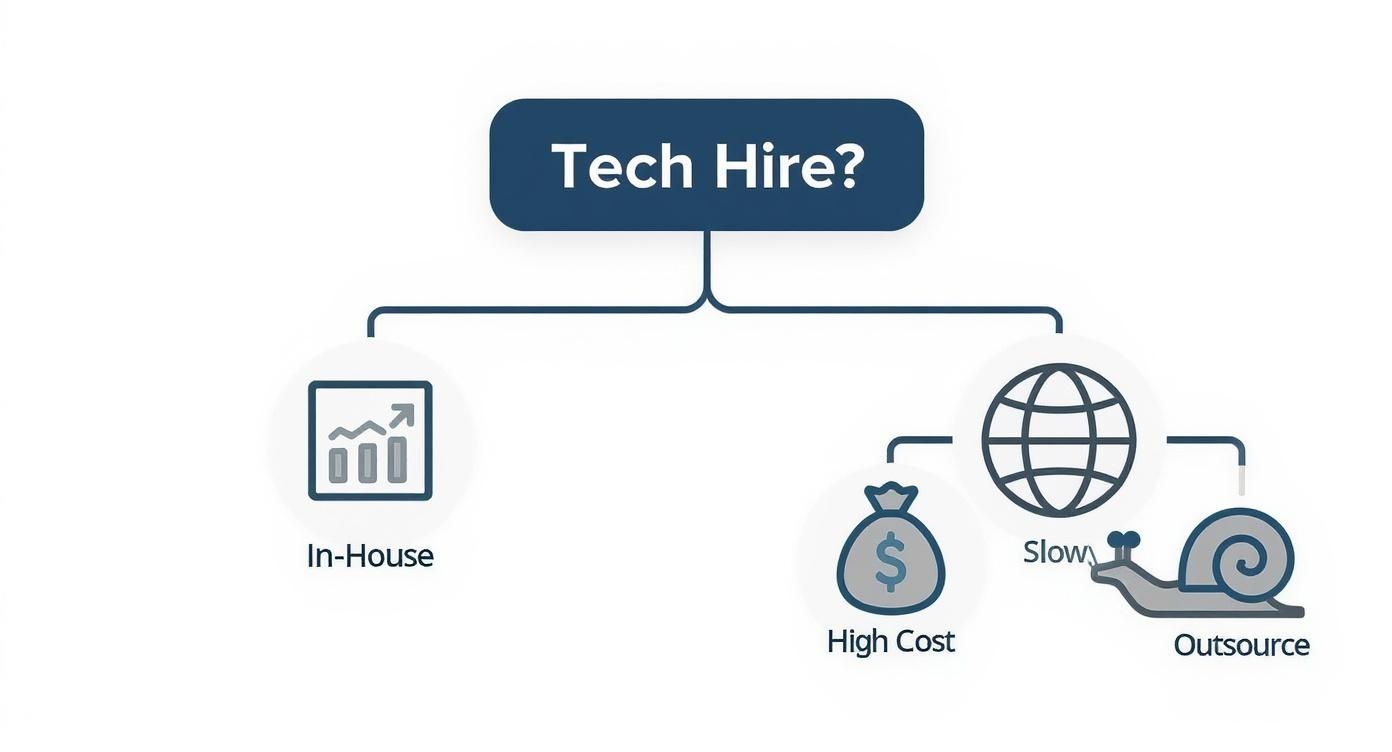
As the graphic suggests, the traditional in-house route often leads to a slow, expensive process, pushing many to explore outsourcing as a more direct path to building their product.
First up is the Fixed Price model. It sounds perfect, right? You get a single number for a defined scope of work. It’s predictable, easy to budget for, and feels safe. It's the comfort food of outsourcing.
Here’s the catch: it only works if your project scope is carved in stone and will absolutely, positively never change. Think building a simple, five-page marketing website. For anything else? It’s a trap.
The moment you need a change—and you will need a change—you’re hit with a change order, another negotiation, and more delays. The fixed price becomes anything but fixed. It forces your vendor to build exactly what's on paper, even if you both discover a better way halfway through. Innovation dies, and you end up with a rigid product that meets the letter of the contract but misses the spirit of your vision.
Next, we have Time & Materials (T&M). This is the pay-as-you-go plan. You pay for the hours worked and the resources used. It’s flexible, agile-friendly, and perfect for projects where the path forward isn't entirely clear. You know, like every startup project ever.
This model is built on trust and transparency. It gives you the freedom to pivot, iterate, and respond to user feedback without the bureaucratic nightmare of change orders. If you want to build a truly great product, you need this kind of flexibility.
The risk? If you don't manage it closely, costs can creep up. You need a partner who provides detailed reporting and a project manager who isn’t afraid to have tough conversations about scope and budget.
Finally, there's the Dedicated Team model. This is less about outsourcing a project and more about extending your own team. You get a group of developers who work exclusively for you, full-time. They become experts in your product, your culture, and your goals.
This is the holy grail for long-term, complex projects. You get the stability of an in-house team without the recruiting headaches and administrative overhead. They’re your team, just located elsewhere. It’s a powerful model for scaling quickly and maintaining a high degree of control and institutional knowledge.
It also blurs the lines with other hiring strategies, and it’s important to understand the nuances between staff augmentation vs. consulting to see which fits your specific operational needs.
The IT outsourcing landscape is constantly shifting. Today, 66% of U.S. businesses outsource at least one department, moving beyond simple cost-cutting to form value-based partnerships. This evolution is heavily influenced by new technology; about 59% of IT outsourcing projects now include AI or machine learning consulting, showing a clear demand for specialized expertise.
To help you decide, here's a no-nonsense breakdown of when to use each model and when to think twice.
| Model | Best For… | Biggest Risk | Founder's Verdict |
|---|---|---|---|
| Fixed Price | Small, tightly-scoped projects with zero ambiguity (e.g., a simple landing page). | Scope Creep. Any change requires a painful and costly contract renegotiation. | Use it for tiny, predictable tasks. For anything innovative, avoid it like the plague. |
| Time & Materials (T&M) | Agile development, MVPs, and projects where requirements will evolve. | Budget Overruns. Without tight management and transparent reporting, costs can spiral. | The default choice for most startups. It offers the flexibility you need to build something people actually want. |
| Dedicated Team | Long-term, complex product development and scaling your core engineering capacity. | Integration Challenges. Requires significant effort to integrate them into your company culture. | The ultimate model for scale. It's an investment, but you get a true extension of your own team. |
Each model has its place, but the key is aligning the engagement type with your project's reality, not just your budget's wishful thinking. To further understand different engagement models, explore the comparison between staff augmentation vs. outsourcing. Each approach offers distinct advantages depending on your project's complexity and your desired level of management.
So, you’ve decided to look beyond your zip code for talent. Smart move. But the global talent pool is a massive ocean, and you need a good map to navigate it. This isn't a geography lesson; it's a strategic breakdown of how your choice of location will directly impact your budget, your sleep schedule, and your product's success.
Let's talk geography. The classic offshore, nearshore, and onshore models all come with distinct pros and cons that vendors won’t always tell you about. Choosing the right region for your IT outsourcing development is less about finding the cheapest hourly rate and more about finding the right value.

Onshore outsourcing means hiring a team within your own country. The main selling point is clear: zero cultural barriers and no time zone headaches. It’s familiar, it feels safe, and communication is seamless.
The downside? You’re paying top dollar for that comfort. You get the convenience, but it comes at a premium that can make your CFO break out in a cold sweat. For most startups and small businesses, this model defeats the entire purpose of looking for external talent in the first place.
This is what most people picture when they hear "outsourcing." You hire a team in a distant location like India, the Philippines, or Eastern Europe to take advantage of significant cost savings. The price tag is undeniably attractive.
But that low hourly rate comes with hidden costs. A 12-hour time difference means someone—probably you—is taking meetings at 10 PM. Cultural nuances can lead to misinterpretations that derail sprints, and you'll spend far more time writing painfully detailed specs just to bridge the communication gap. It can work, but it requires a level of process and oversight that many founders simply don't have time for.
Nearshore outsourcing is the pragmatic middle ground. This involves partnering with teams in nearby countries with similar time zones, like a US-based company hiring developers from Latin America.
This model is exploding in popularity for a reason. You get the cost benefits of a global talent pool without sacrificing your workday. Collaboration happens in real-time, cultural affinity is generally high, and you can actually build a real relationship with your team. This isn’t just about convenience; it’s about efficiency.
For a founder, a two-hour time difference is a minor inconvenience. A twelve-hour difference is a lifestyle change. Nearshoring lets you build a world-class team without becoming a full-time night owl.
Exploring different regions is key to finding the right fit for your company culture and technical needs. If you’re considering this path, you might be interested in our deep dive into the best countries for outsourcing to get a more granular view.
You’ll also hear the term friendshoring thrown around. It’s a newer concept that builds on nearshoring by prioritizing partnerships in countries with strong political and economic alignment. Think of it as an added layer of risk mitigation, ensuring your operations aren’t vulnerable to geopolitical instability. For businesses that need long-term stability, it’s becoming more than just a buzzword.
The global market for IT outsourcing is immense. The United States leads in revenue, expected to hit $213.6 billion in 2025, but emerging hubs are catching up fast. Latin America's market, for instance, is forecasted to grow at over 10% CAGR between 2025 and 2030, largely driven by this surge in nearshoring and friendshoring. You can discover more insights about these global outsourcing trends on 10pearls.com.
Ultimately, your choice of location is a strategic one. Don’t just look at the hourly rate. Consider the total cost of collaboration—your time, your team’s energy, and the speed at which you can actually ship your product.
Finding the right partner for your IT outsourcing development can feel a lot like online dating for your company—you're faced with a sea of promising profiles, slick presentations, and a terrifyingly high potential for disaster. Everyone looks great on paper. The real question is, how do you find ‘the one’ who won’t ghost you after the first big invoice?
Let's be clear: a flashy portfolio and a low hourly rate are the worst metrics to judge a potential partner by. That’s like choosing a spouse based on their favorite color. You have to dig deeper. This isn't just about hiring a vendor to write code; it's about finding a co-conspirator who will live and breathe your product.

Any decent agency can put together a gallery of shiny, finished products. Don't fall for it. The real magic—or mayhem—happens in the process. Your mission is to uncover how they really work, not just what they’ve managed to build.
You need to start asking the tough questions that make salespeople squirm:
The global IT outsourcing market is absolutely booming, projected to hit well over $800 billion by 2025 and potentially top $1 trillion by 2030. With that much money flying around, the number of vendors is exploding, making your vetting process more critical than ever.
Signing a six-figure contract based on a few Zoom calls is pure insanity. Yet, founders do it every single day. There’s a much better way to test the waters without committing your entire runway.
It’s called a paid discovery project or a scoping sprint.
Here’s the breakdown: you hire the potential partner for a small, fixed-fee project that lasts one or two weeks. The goal isn't to build a feature, but to produce a tangible planning artifact. This could be a technical specification, a set of wireframes, or a detailed project roadmap.
This small investment is the single best predictor of a successful long-term relationship. It forces both sides to move beyond sales pitches and actually work together, revealing everything you need to know about their communication, technical chops, and problem-solving skills.
By the end of this mini-project, you'll know for sure. Did they communicate proactively? Were their deliverables crisp and clear? Did they feel like part of your team? If the answer to any of these is "no," you just saved yourself a mountain of future pain for the price of a small, controlled experiment.
The success of your outsourcing venture hinges on selecting the right partner. For detailed guidance on this critical decision, refer to this excellent guide on How to Choose a Software Development Company.
Finally, don't just ask for references—interrogate them. Most vendors will hand you a list of their happiest clients, so you need to ask questions that uncover the truth between the lines.
Forget asking, "Were you happy with the result?" and try these instead:
Their answers will tell you more about the partner’s character and resilience than any polished case study ever could. A good partner shines brightest when things get tough. A bad one just sends invoices.
You’ve picked a model and vetted a partner who seems to get it. Great. Now comes the part that actually determines whether your IT outsourcing development project succeeds or spectacularly face-plants.
Let’s be honest: your partner’s job is to ship incredible code. Your job is to create an environment where they can do just that. Success isn’t about trust falls; it’s about building trust through painfully clear communication, rock-solid project management, and expectations so well-defined they're impossible to misinterpret.
The biggest mistake I see founders make is thinking more meetings equals better communication. It doesn’t. Real communication is about building a system where information flows effortlessly and asynchronously, with zero ambiguity. The goal is to empower your remote team to build, not guess.
Don’t just hand over a feature list and expect magic. You need to provide the 'why' behind the 'what.' Your outsourced team can't read your mind, but they can build brilliant solutions if you give them the business context they need to make smart decisions on their own.
A weekly sync-up call isn't a communication strategy—it's a crutch for a broken process. True collaboration happens in the details: the well-written user stories, the thoughtful pull request comments, and a shared understanding of the mission.
Without a disciplined process, you don’t have an outsourced team; you have a very expensive liability. Your partner should absolutely bring their own agile framework to the table, but it's on you to own the inputs and the outcomes.
Here’s a no-fluff framework to keep your remote project from spiraling into chaos:
Ultimately, your partner’s success is a direct reflection of your own leadership. Providing this level of clarity isn't micromanagement. It's the unsexy, essential groundwork that frees up brilliant engineers to do what you hired them for: build an amazing product.
Alright, we've covered the models, the maps, and the management theories. Now it’s time to get practical. This isn't just a list of friendly suggestions; think of it as your pre-flight checklist before you commit a single dollar to an external team.
Consider this the one-page summary you print out and tape to your monitor. It’s here to keep you focused and save you a world of pain later on. Get any of these steps wrong, and you're not saving money—you're just buying yourself future headaches.
Let's get tactical. Before you sign anything or even start shortlisting partners for your IT outsourcing development, you need clear, written answers to these questions. Vague ideas simply won't cut it.
Define Your "Why" With Brutal Honesty. Are you really just trying to cut costs? Do you need specific skills you can’t find locally? Or is this all about moving faster than the competition? Your primary driver here changes everything, from the engagement model you pick to the region you should be looking in.
Scope It Until It Hurts. Document the initial project scope with obsessive detail. What are the absolute, non-negotiable features for version one? What does a successful outcome look like in 90 days? A fuzzy scope is basically a blank check for disaster.
Establish the Cadence of Communication. How are you going to talk to each other? Daily stand-ups on Slack? Weekly video calls? Define the tools, the schedule, and the expectations for response times before the project kicks off. Ambiguity here is a notorious project killer.
A checklist isn't about adding bureaucracy. It's about creating a system that protects you from your own worst impulses—like jumping at a low hourly rate or skipping due diligence because you're in a hurry.
Following these steps isn't optional. It’s the unglamorous but essential work that separates successful outsourcing stories from the cautionary tales you hear at industry meetups. Get this part right, and you're not just hiring a vendor; you're building a real strategic advantage.
You've made it this far, so you're clearly serious about this. But I'll bet a few questions are still rattling around in your head. Let's get them out in the open and answer them with the kind of straight talk you won't get from a sales deck.
Easy. The single biggest mistake is treating your IT outsourcing development partner like a vending machine. Founders just "throw the project over the wall" and expect a flawless product to pop out the bottom. They skimp on communication, offer vague requirements, and fail to treat the external team like, well, a team.
Here's a newsflash: you can't outsource ownership.
The magic happens when you treat your outsourced developers as extensions of your own crew. Give them context. Give them access. Give them respect. A cheap vendor you barely speak to is a hundred times more expensive than a great partner you collaborate with daily.
Ah, the million-dollar question. I'd love to give you a clean, simple number, but the truth is, rates are all over the map. They swing wildly based on geography, seniority, and the engagement model you choose. You’ll see figures from $25/hour in some offshore markets to $150+/hour for top-tier nearshore or onshore talent.
But honestly, you're asking the wrong question.
Stop obsessing over the hourly rate and start focusing on the 'total cost of ownership.' A 'cheap' developer who needs constant hand-holding and writes buggy code will cost you a fortune in delays and rework. They're a bigger liability than an expert who delivers clean work from day one.
Your goal isn't the cheapest rate; it's the best value. It's about finding the fastest, most efficient path to a product that’s ready for the market and won't crash the second a real user logs in.
This one's actually pretty simple. It all boils down to how much time you have to manage people.
A freelancer can be perfect if you have a very specific, well-defined task and you've got the technical background to oversee their work directly. I hope you enjoy spending your afternoons vetting résumés and running technical interviews, because that’s now your second job.
An agency, on the other hand, gives you a managed team. That package usually includes project management, quality assurance, and a built-in layer of accountability. Yes, it costs more upfront, but you're buying a pre-built process. For founders who need to be building the business—not managing individual coders—that process is often worth its weight in gold.