

An agile development team is a small, cross-functional group of people who have all the skills needed to build and ship a product, piece by piece. Forget siloed departments—this is a self-contained unit built for speed, collaboration, and adapting on the fly.
Let's be real. Tossing the word "agile" into job descriptions won't magically make your projects ship on time. You’ve probably heard the buzzwords and maybe even bought some slick project management software, but the real engine behind agile isn't a tool—it's the people and how they're organized.
This is exactly where most companies get it wrong. They want the sizzle without the steak. They crave the speed and flexibility of agile without actually building a proper agile development team structure.
The hard truth? A foosball table and free snacks don’t create a high-performing team. A well-designed structure does. Before we get into the nitty-gritty, it helps to understand what agile development methodology entails at its core. Nailing the structure means creating small, focused units that can build, test, and release value without getting bogged down by endless meetings and bureaucratic handoffs.
This isn’t some trend for Silicon Valley startups anymore. The adoption of agile has exploded, with roughly 86% of software development teams now using these practices. What’s more, agile isn't just for coders. It has spread into non-technical areas, with 68% of business units across various departments adopting agile frameworks. This shows a massive shift in how modern companies operate.
Think of your team’s structure as the operating system for your entire development process. A buggy OS crashes constantly, no matter how good the apps are. A clean, efficient OS lets everything run smoothly.
We’re cutting through the fluff to focus on what actually works: creating a team that’s built to ship, not just look busy. This isn’t about jargon; it's about results.
Here’s a quick look at the frameworks we'll be covering. Don't worry about the details just yet—this is just a high-level map to get you oriented before we dive in.
| Framework | Best For | Core Principle |
|---|---|---|
| Scrum | Complex projects with changing requirements. | Time-boxed iterations (Sprints) and defined roles. |
| Kanban | Continuous delivery and workflow optimization. | Visualizing workflow and limiting work in progress. |
| Spotify Model | Scaling agile across multiple teams and departments. | Autonomy and alignment through Squads, Tribes, and Guilds. |
Getting your team structure right from the start is non-negotiable for a few key reasons:
This is your blueprint for a team that delivers. Let's get to it.
Building an agile team without the right people in the right seats is like trying to assemble a race car with the wrong parts. It’s messy, nothing fits, and it’s definitely not going anywhere fast. You can’t just toss a group of talented people into a room, tell them to "be agile," and expect magic.
A successful agile development team structure needs clearly defined roles and responsibilities. Get this foundation right, and you’ll have a self-sufficient, high-performing engine. Get it wrong, and you’ve just set up a very expensive social club.
First, every team needs a Product Owner. Think of this person as the voice of the customer and the final authority on what gets built. They don’t manage the team’s day-to-day tasks; their domain is the product backlog—the prioritized list of features and fixes that guides the entire project.
Their job is to be obsessed with delivering value. They’re constantly asking: Will this feature actually make a difference for our users? Does this solve a real problem or just a perceived one? They spend their time talking to stakeholders, digging into data, and ruthlessly prioritizing the backlog to make sure the team is always working on the most important thing next.
A catastrophic mistake many companies make is assigning the CEO or another C-suite executive to this role.
That’s a terrible idea. A Product Owner needs to be in the trenches with the team every single day, ready to answer questions and clarify requirements on the fly. A drive-by PO who only shows up once a week is a recipe for delays, frustration, and ultimately, building the wrong product.
Next up is the Scrum Master, probably one of the most misunderstood roles in agile. They aren't the team's boss or a project manager with a fancy new title. A better way to think of them is as part coach, part facilitator, and part obstacle-remover.
The Scrum Master's entire purpose is to help the team become more effective. They do this by:
They serve the team, not the other way around. Their success is measured by how well the team is performing. For a closer look at how this plays out in practice, it’s worth exploring some established agile methodology best practices to see how this role supports the sprint cycle.
Finally, we have the Development Team. These are the experts who actually design, build, test, and ship the product. This isn't just a group of coders; it includes everyone needed to take an idea from the backlog and turn it into a finished piece of software—designers, QA analysts, database engineers, and anyone else required for the job.
The best development teams are both cross-functional and self-organizing. This means they have all the skills needed internally to get the work done without constantly waiting on outside help. It also means they get to decide how they’ll tackle the work. The Product Owner defines the "what," but the Development Team owns the "how."
One of the biggest myths about dev teams is the idea of a "team of generalists." While having T-shaped skills (deep expertise in one area, with broad knowledge in others) is incredibly valuable, a team of pure generalists often becomes a team of masters of none. You need specialists who can collaborate effectively, not a group where everyone is just okay at everything.
Without these three core roles working in harmony, your agile ambitions will stall out before you even finish your first sprint.
Alright, so you’ve got the right people in the right seats. Now, how do they actually work together? This isn’t a one-size-fits-all situation. Picking an agile framework is like choosing an operating system for your team—some are built for raw speed and flexibility, others for structure and predictability.
Don't just pick the one that sounds coolest on a tech blog. You need to choose the structure that fits your company's DNA and the type of work you actually do. Let's put the most popular models head-to-head in a practical, no-fluff showdown.
Scrum is the most popular kid in the agile high school for a reason. It’s built around short, time-boxed cycles called sprints, which usually last two to four weeks. At the end of each sprint, the team is expected to deliver a potentially shippable piece of the product.
This framework thrives on rhythm and predictability. If your work involves building a complex product with evolving requirements—like a new SaaS platform—Scrum is your best bet. The fixed sprint length forces the team to break down huge, intimidating projects into manageable chunks. You can see how this rhythm fits into the bigger picture in our guide to the software development life cycle explained.
Think of Scrum as a series of deadlines. It creates a powerful sense of urgency and focus that helps teams deliver consistently. It’s not for everyone, but for teams building new products from the ground up, that predictable cadence is gold.
The key roles we just discussed—Product Owner, Scrum Master, and Development Team—are all formally defined and essential for Scrum to function. Here's a quick look at how they fit together.
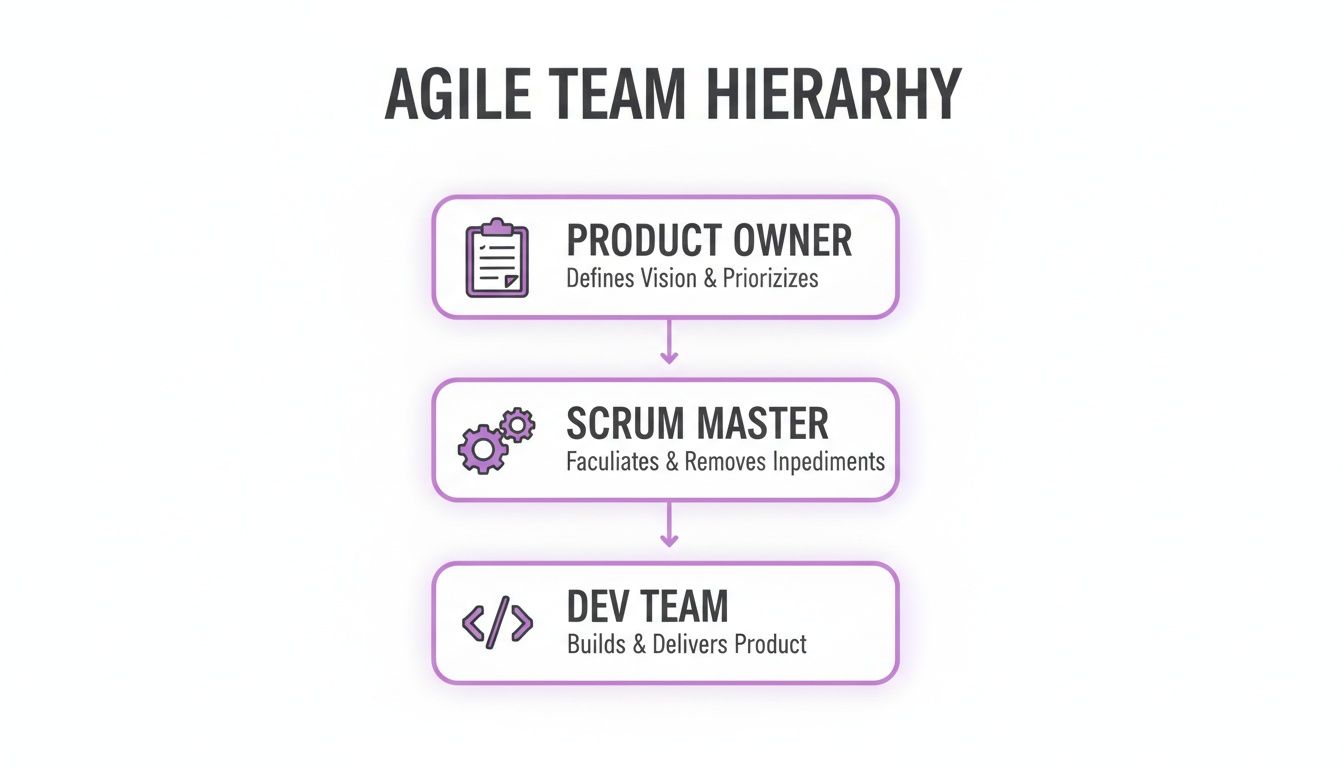
This structure is designed to give the Product Owner control over the "what," the Development Team control over the "how," and the Scrum Master the job of making sure it all runs smoothly.
Now, what if your work doesn't fit neatly into two-week boxes? Imagine a support team fixing bugs or an ops team handling infrastructure requests—their work is unpredictable. Forcing them into sprints would be like trying to fit a square peg in a round hole.
Enter Kanban. Instead of focusing on time-boxed sprints, Kanban is all about visualizing workflow and managing the flow of work. The goal is simple: move tasks from "To Do" to "Done" as smoothly and efficiently as possible. It’s a pull system—when the team has capacity, they pull the next highest-priority item from the backlog. No artificial deadlines.
The primary tool is the Kanban board, which gives everyone a clear, visual map of the team's entire process. By limiting the amount of work in progress (WIP) at each stage, teams can instantly spot bottlenecks and prevent individuals from getting overloaded.
So, which one should you pick? There's no single right answer, but this table should help clarify which framework aligns better with your team's needs.
| Feature | Scrum | Kanban |
|---|---|---|
| Cadence | Fixed-length sprints (2-4 weeks). Creates a predictable rhythm. | Continuous flow. Tasks are pulled from the backlog as capacity allows. |
| Best For | Complex projects with evolving scope, like new product development. | Teams with unpredictable work, like maintenance, support, or operations. |
| Key Metric | Velocity—how much work a team can complete in a sprint. | Cycle Time—how long it takes for a single task to move from start to finish. |
| Roles | Formal roles are required: Product Owner, Scrum Master, Development Team. | No prescribed roles. Teams are encouraged to evolve roles as needed. |
| Meetings | Prescribed ceremonies: Sprint Planning, Daily Scrum, Sprint Review, Retrospective. | No required meetings. Teams can add them as they see fit (e.g., daily stand-ups, replenishment meetings). |
| Changes | Scope is locked during a sprint to protect focus. Changes are added to the backlog for the next sprint. | Changes can be made at any time, as long as they don't disrupt current work-in-progress. |
| Delivery | Delivers a working increment of the product at the end of each sprint. | Can deliver value continuously, as soon as a task is complete. |
Ultimately, Scrum gives you structure and predictability, which is fantastic for building something new. Kanban offers flexibility and visibility, which is perfect for managing a steady stream of incoming work.
Ah, the infamous Spotify Model. It sounds amazing, with its "Squads," "Tribes," "Chapters," and "Guilds." It promises the perfect blend of autonomy and alignment, a world where small, independent teams work in perfect harmony.
Here’s the blunt truth: it’s not a framework. It was just a snapshot of how one company organized itself at a specific point in time to solve its own unique scaling problems. In fact, even Spotify doesn't use the "Spotify Model" anymore.
Trying to copy-paste it into your organization is a classic rookie mistake. The real lesson from Spotify isn't their specific structure, but their guiding principles: trust your teams, give them autonomy, and build a culture of continuous learning. Take the inspiration, but don't take the blueprint.
Ah, Jeff Bezos’s famous “two-pizza rule.” Everyone loves quoting it: if you can’t feed a team with two large pizzas, it’s too big. It’s a catchy soundbite, for sure. But as an actual strategy for building a high-performing team? It’s terrible.
When it comes to structuring a successful agile development team, size is one of the most critical dials you can turn. Just winging it with a clever phrase is a recipe for disaster.
Get the size wrong, and you’re just setting yourself up for failure. A team that's too small simply doesn't have the diverse skills or the sheer bandwidth to tackle complex problems. Have you ever seen a three-person "team" try to build, test, and ship a major feature? It’s a one-way ticket to burnout city.
On the flip side, let a team get too big, and you create an entirely different kind of monster. The problem boils down to simple math. The number of communication lines in a group doesn’t grow in a straight line; it explodes exponentially. A team of five has ten communication channels. Bump that up to a team of ten, and you’re suddenly managing a staggering forty-five. Keeping everyone aligned starts to feel like a full-time job in itself.
So, what's the magic number? Ask any seasoned agile coach, and they’ll likely tell you the sweet spot is somewhere between five and nine members, not counting the Scrum Master or Product Owner. This isn't just a gut feeling; there's real science behind it.
The idea links back to principles like Dunbar's number, which suggests we have a cognitive limit on how many stable social relationships we can maintain. In a team setting, this means that once you push past a certain size, that feeling of unity starts to crumble. People stop acting like a single unit and start splintering into subgroups.
In a team of five, everyone knows what everyone else is working on. In a team of fifteen, you’re lucky if everyone knows each other's names. The goal is high-bandwidth communication, not running an internal conference call.
This magic number of 5-9 ensures your team is:
What happens when your team naturally grows past nine people? Whatever you do, don't just keep cramming more chairs into the daily stand-up. It’s time to split. I know, it sounds painful, almost like breaking up a band. But trust me, keeping an oversized team together is far more damaging in the long run.
The key is to split them intelligently. Don't just draw a line down the middle of a spreadsheet. Divide them based on product areas, customer journeys, or distinct architectural components. For example, you could create one team focused entirely on the user onboarding experience and another dedicated to the core search functionality.
This move creates two smaller, highly focused teams that can move faster and develop deep ownership over their respective domains. You avoid the communication silos that kill agility. By giving each new team a clear mission and the autonomy to run with it, you're scaling your development capability without grinding everything to a halt. It’s not about adding more people to one team; it’s about creating more high-performing teams. This is how you build a structure that can actually grow with your company.

Let's get straight to the point: the bottom line. Does reorganizing your developers into a trendy new agile development team structure actually move the needle on your profit and loss statement? Or is it just another excuse to buy more whiteboards and look busy?
The answer is a resounding yes—but it comes with a massive catch. It only works if you commit. A half-hearted agile setup is worse than useless; it’s just chaos with more meetings.
A properly implemented team, however, becomes a serious competitive advantage. This is the part of the conversation you bring to your CFO.
Sure, agile can boost morale. Happy developers are great, but happy accountants are even better. The real impact is on the hard numbers that drive your business forward. We’re not just talking about anecdotal wins here.
Well-oiled Scrum teams have been shown to achieve up to a 250% improvement in product quality by dramatically slashing defect density. On top of that, agile teams often report working 25% more productively than their traditional counterparts. You can dig into more of these agile statistics to see the full picture.
This isn't just about shipping faster; it's about shipping better. That directly reduces costly rework, lowers customer churn, and frees up your team to build new things instead of fixing old ones.
A well-structured agile team isn't a cost center; it's a value-creation engine. It transforms your development process from an unpredictable expense into a reliable, profit-driving asset.
These aren't vanity metrics. Better quality means happier customers, fewer support tickets, and a stronger brand. Higher productivity means you can out-innovate your slower competitors. It’s that simple.
Beyond the headline numbers, a great agile team structure delivers some powerful "hidden" returns that are just as crucial for long-term success. These are the things that don't always show up neatly on a spreadsheet but can make or break a company.
Here’s what you’re really getting:
A proper agile development team structure isn’t just a tech fad. It’s a sound business investment that pays dividends in speed, quality, and predictability. It’s how you build a product development machine that can consistently deliver value and adapt to whatever the market throws at it.
Okay, you're sold on the structure, the roles, and the ROI. Now comes the fun part: finding the actual humans to fill these roles. Turns out there’s more than one way to hire elite developers without mortgaging your office ping-pong table.
It turns out, you don’t have to limit your search to a 20-mile radius around your office. In fact, that's probably the most expensive mistake you can make. The real game-changer is looking beyond your borders.
Let’s be blunt. The cost of top-tier tech talent in major US hubs has gone from expensive to absurd. But what if you could get the same caliber of professional—or better—at a fraction of the cost? This isn't a fantasy; it's about looking in the right places.
I’m talking about leveraging a global talent pool, and I’ve found the sweet spot is Latin America. Why? Because you get world-class engineers, designers, and product owners who operate in your time zone. Forget those late-night calls and disjointed stand-ups; you get the real-time collaboration that Agile demands.
This isn't about finding "cheap" labor. It’s about finding incredible value. You tap into a massive, highly skilled market without the insane salary overhead of Silicon Valley or New York.
Think of it this way: are you paying for a developer's talent or for their zip code? By going remote the right way, you get to invest in skill, not just real estate.
But finding these people is a nightmare, right? Sifting through endless résumés, scheduling screening calls, running technical interviews… Hope you enjoy spending your afternoons fact-checking resumes and running technical interviews—because that’s now your full-time job.
The old way of hiring is broken. It’s slow, biased, and wildly inefficient. The modern playbook uses smarter tools to solve this problem. Instead of drowning in applications, you can use AI-powered vetting to find candidates with the exact skills you need, almost instantly.
This approach completely flips the model:
This process handles the heavy lifting, letting you focus on the final interviews with a small group of top contenders. If you're serious about this strategy, you'll need a partner to help you hire remote developers without the usual headaches.
Once you find your dream team, you still have to deal with cross-border HR, payroll, and all the legal compliance headaches. This is where most founders give up. But the right platform handles all of it for you—payroll, benefits, compliance—making it as easy as hiring someone down the street. It’s the insider playbook for scaling your agile team with world-class talent.
Let's wrap up by tackling some of the most common questions I hear when people are setting up their own agile teams. No jargon—just straight answers to the things you're probably wondering about.
Yes. 100% yes. And if anyone tries to tell you otherwise, they're missing the entire point of Agile. I’ve seen marketing teams use Kanban boards to manage their entire content pipeline, from a rough idea to a published article. HR teams can adopt Scrum-style sprints to handle a massive hiring push.
The core ideas—working in cycles, giving people clear ownership, and getting constant feedback—aren't about software. They're about getting complex work done effectively. The trick is to adapt the framework to your team's workflow, not the other way around. Forget the tech-speak and focus on two things: making the work visible and breaking big projects into small, achievable steps.
Easy. The "part-time" team member. It's the silent killer of productivity and morale.
Agile is built on deep focus. When you split a product owner or a key developer across three different "agile" teams, you don't get 33% of their brilliant work on each project. You get 100% of their context-switching exhaustion. It just doesn't work.
A dedicated, cross-functional team that owns a problem from start to finish will always outperform a group of fractional resources. Protect your team's focus like your company's life depends on it—because it probably does.
It's always tempting to spread your star players thin to cover more ground, but it's a losing strategy every single time. Commit to dedicated teams, and you’ll see a night-and-day difference in what they can accomplish.
It’s not just possible; it’s become the standard for fast-growing companies. But you can't just ship everyone a laptop and hope for the best. Running a remote agile team requires being incredibly intentional.
It all boils down to deliberate communication and the right tools. You have to over-communicate everything. Daily stand-ups are non-negotiable, and video should always be on to build that human connection. You also need a digital hub like Jira or Trello that everyone agrees is the single source of truth for all work—no side DMs or surprise requests.
Finally, and this is crucial, you must enforce core working hours with significant time zone overlap. This is where hiring talent from similar time zones, like Latin America for U.S.-based companies, becomes a massive strategic advantage. It allows for the real-time collaboration that agile depends on, turning a potential remote work challenge into a powerful asset.

