
Verifying a candidate’s employment history is about more than just checking boxes. It’s the process of confirming job titles, tenure, and reasons for leaving with their previous employers. This can be done by calling HR, using a third-party service, or even digging into pay stubs and tax records. The goal is simple: make sure the person on paper is the person you’re about to trust with your business.
Let's be honest: for most managers, verifying a candidate’s work history feels like a chore you’d happily delegate to an intern. It’s tedious, awkward, and often feels like a pure formality.
But getting it wrong? That’s how you end up with a five-figure bad hire who costs you thousands in wasted salary, recruitment fees, and a nosedive in team morale.
We’ve seen it all. Phantom companies that exist only as a cheap landing page, fabricated timelines that conveniently hide a six-month "sabbatical," and technical skills that look great on paper but vaporize during the first real project. This isn't just about catching liars; it's about protecting your business from completely preventable mistakes.
The classic method—that cringey, hopeful call to a past manager—is fundamentally broken in today's remote, global hiring landscape.
First off, good luck even finding the right person. People move on, companies get acquired, and HR departments are often firewalled, instructed only to confirm basic dates of employment. You’re left playing detective, and your afternoons disappear into a black hole of unanswered calls and vague email responses. Hope you enjoy spending your afternoons fact-checking resumes—because that’s now your full-time job.
Even if you do get someone on the line, what are they really going to say? Few former managers will give you the unvarnished truth for fear of legal blowback. You'll get a bland, sanitized summary that’s about as useful as a chocolate teapot.
The reality is that resumes are marketing documents, not legal affidavits. The numbers back this up. More than three-quarters of companies globally find discrepancies in candidate backgrounds, with employment history being the most common area for fudged details.
In fact, for every five candidates screened, about 13% of employers find a discrepancy. Add to that the rise in identity fraud—where one in six businesses report a confirmed case during hiring—and you're facing a serious challenge. You can find more details about these hiring risks in recent security reports from leading industry analysts.
The bottom line is this: winging it is no longer an option. Trusting a polished PDF and a charming interview is a recipe for disaster, especially when hiring top-tier remote talent from countries where you don’t have local context. This is the 'scared straight' intro you need before we get to the playbook. What’s at stake is just too high to leave to chance.
The gap between the old, manual way of doing things and modern, automated verification isn't just about convenience—it's about outcomes. One drains your resources for questionable results, while the other gives you reliable data and frees up your team to focus on what actually matters.
Here's a side-by-side look at the reality of each approach.
| Verification Aspect | The Old Manual Way (Your Afternoons) | The Smart Automated Way (Your Future) |
|---|---|---|
| Time Investment | Hours, sometimes days, of phone tag and email chasing. Your time is worth more. | Minutes. Set it up, and the system does the heavy lifting while you interview. |
| Accuracy & Reliability | Relies on subjective, often legally-cautious human memory. High potential for error. | Verifies against objective data sources (payroll, tax records), removing human bias. |
| Candidate Experience | Awkward and slow. Candidates are left waiting while you play detective. | Smooth and professional. Candidates provide consent and data in a secure, streamlined portal. |
| Global Scalability | A logistical nightmare. Different time zones, languages, and compliance rules. | Built for global hiring. Handles cross-border compliance and local nuances automatically. |
| Cost | Hidden costs are huge: your salary, lost productivity, and the high price of a bad hire. | A predictable, fixed cost that delivers a clear ROI by preventing costly hiring mistakes. |
Choosing the right method isn't just an operational decision; it's a strategic one. Automation doesn't just save you from headaches—it gives you a competitive edge by helping you hire smarter and faster.
Alright, let's get tactical. Enough with the horror stories and grim statistics. If you're tired of playing resume roulette, it's time to build a verification playbook that actually works—one that doesn't feel like you’re mortgaging your afternoons to chase down ghosts.
This isn't about creating more bureaucracy. It's about building a simple, tiered system that adapts to the risk of the role you're hiring for. Think of it as a series of gates; the more critical the hire, the more gates they need to pass through.
The manual way of verifying employment history is slow and painful, while automation makes it faster and more reliable. This simple flow shows the transition from tedious desk work to efficient, data-driven validation.
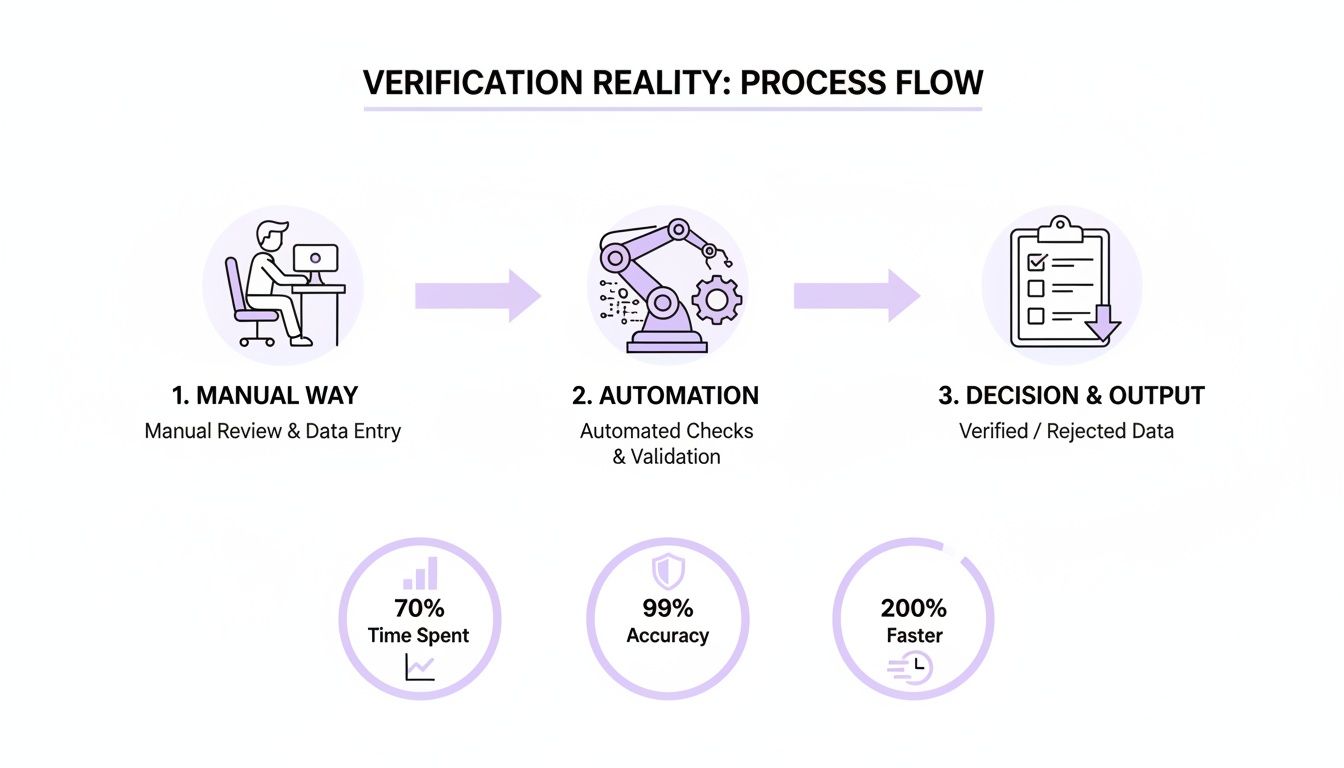
This visualization hammers home the core benefit. Automation isn't just about speed; it's about reclaiming your time for strategic work instead of administrative drudgery.
Before you even think about picking up the phone or sending an email, you need to collect the right ammunition. The goal here is to get objective, hard-to-fake evidence directly from the candidate. This front-loads the work and weeds out the obvious fabricators from the start.
Here's the non-negotiable list of what to ask for, especially when hiring across borders in Latin America:
Don't just ask for this stuff—explain why you need it. Frame it as a standard part of your process to ensure a fair and accurate evaluation for everyone. Honest candidates will get it; dishonest ones will get defensive. That’s your first filter right there.
Once you have the documents, it's time to start verifying. Not every role needs the same level of scrutiny. A junior designer doesn’t need the same deep-dive background check as your new head of finance.
Here’s our three-tiered approach.
This is your baseline check for every candidate. It’s fast, free, and surprisingly effective at spotting glaring inconsistencies.
This isn't about snooping; it's about basic due diligence. It takes 15 minutes and can save you from wasting hours on a fraudulent candidate.
If the social scan checks out, it’s time for direct contact. But forget calling the manager—they’re biased and legally constrained. Go straight to the source: the HR department. Their job is to manage official records, not offer subjective opinions.
Your email needs to be direct, professional, and easy to respond to. Don't ask open-ended questions. Ask for simple, factual confirmation of:
That's it. This isn't the time to conduct a reference check; that's a separate beast entirely. For more on that, you can check out our guide on how to conduct reference checks for a complete breakdown.
For senior roles, key leadership positions, or anyone handling sensitive data, it's time to call in the professionals. Third-party verification services are your best friend here. They have the expertise, access to databases, and on-the-ground resources to verify information in different countries that you simply don't.
Yes, it costs money. But the price of a comprehensive background check (often a few hundred dollars) is a rounding error compared to the $17,000 an average bad hire can cost your business. To build a robust and efficient verification process, exploring proven business process improvement techniques can help you integrate these third-party services seamlessly into your workflow.
This isn’t about being paranoid; it's about being pragmatic. This playbook gives you a scalable, repeatable system to verify employment history, protect your company, and hire with confidence.
At some point, you have to ask yourself a hard question: is your time better spent building your company or chasing down a former HR manager in Bogotá who may or may not answer your email?
I’ve been there. The DIY approach to verifying employment history feels scrappy and smart—until it isn’t. It’s that moment you realize you’ve burned an entire Tuesday on a wild goose chase that could have been solved with a credit card and a smart decision.
This is where third-party verification services come in. But let’s be clear: not all are created equal. This isn’t about just picking the cheapest name on Google. It's a strategic choice about when to stop doing it yourself and start paying for expertise.
Figuring out the exact moment to hand over the reins isn't always obvious. For us, it came down to a few clear triggers. If any of these sound familiar, it's probably time to make the call.
You should seriously consider outsourcing if you find yourself in these situations:
Let’s be blunt: if your verification process involves you personally scrolling through LinkedIn profiles for clues, you're doing it wrong. Your focus should be on building the business, not playing detective.
The move to outsource isn't just a gut feeling; it's a massive market trend for a reason. Businesses are increasingly shifting this work to specialists because they demand speed and compliance, especially for cross-border checks.
In fact, the global employment screening market hit approximately $4.73 billion in 2024 and is projected to keep climbing. The specific employment verification slice of that pie was estimated at $1.924 billion in 2025 and is forecasted to reach $3.14 billion by 2031. That kind of growth tells you everything you need to know about the demand for specialized help. You can dig deeper into these employment screening market trends on Cognitive Market Research.
It’s easy to look at the invoice from a verification service and wince. "A few hundred bucks just to confirm a job title? I can do that myself!"
This thinking is a trap. It completely ignores the hidden costs of the DIY method and the massive upside of getting it right.
The $500 Hello vs. The $17,000 Goodbye
A comprehensive background check might run you anywhere from $100 to $500, depending on the role's seniority and location. Now, stack that against the average cost of a single bad hire, which can easily top $17,000 in recruitment fees, wasted salary, and lost productivity.
That upfront cost isn't an expense; it's an investment in risk mitigation. You're paying to avoid a five-figure mistake. You’re paying for the peace of mind that comes from knowing the person you’re about to hand the keys to is exactly who they say they are.
Using professional services isn't an admission of failure. It's the mark of a mature organization that knows where to focus its resources. It protects your business, professionalizes your hiring, and—most importantly—lets you get back to the work that actually matters.
Alright, let's talk about the part of the process that can keep founders up at night. Messing up legal compliance isn't just a headache; it's a potential lawsuit waiting to happen.
This isn't about becoming a lawyer overnight. But you absolutely need to understand the rules of the road before you start digging into a candidate’s past.
Think of it this way: you're handling someone's personal, sensitive data. One wrong move, and you’re not just risking a bad hire—you're risking your company's reputation and a nasty legal bill. This gets even more complicated when you're hiring remotely across international borders.
Before you do anything—before you send a single email or make one phone call—you must get explicit, written consent from the candidate. This is non-negotiable. A verbal "sure, go ahead" in an interview just doesn't cut it.
You need a clear, standalone document that outlines exactly what you'll be verifying and who you might contact. This isn't just a box-ticking exercise; it's your first line of defense. It proves the candidate understood and agreed to the process.
If a candidate hesitates to sign a standard consent form, that’s a red flag the size of a billboard. Honest candidates with nothing to hide expect this step. Evasiveness here is often a sign of bigger issues to come.
Your consent form doesn't need to be 20 pages of legalese. It should be simple, stating that you'll be contacting former employers to confirm their:
Keep it straightforward. The goal is transparency, not intimidation. This is a fundamental aspect of any robust pre-employment screening process, ensuring everything is done above board.
Hiring from Latin America is a game-changer, but it means you're playing in a global sandbox with different rules. You can't just apply US-based assumptions to data privacy laws in countries like Brazil or Mexico.
Laws like Europe’s GDPR have inspired similar regulations worldwide, such as Brazil's Lei Geral de Proteção de Dados (LGPD). These laws are strict about how you collect, process, and transfer personal data across borders.
Here’s a simple breakdown of what you need to respect:
Ignoring these principles is just asking for trouble. Fines for non-compliance can be massive, and pleading ignorance won't get you very far. The goal here isn't to scare you; it's to make you smart.
Building a legally defensible verification process from day one protects you, your company, and the great candidates you want to hire.
Alright, time for a little self-aware plug. (toot, toot!) After years of battling the soul-crushing grind of manual verification—the endless email chains, the awkward phone calls, the nagging uncertainty—we decided there had to be a better way. So, we built it.
This isn't just a sales pitch. It’s a look under the hood at how we use technology to solve the exact problems we’ve been talking about. Because honestly, spending your days chasing down HR reps in different time zones is a terrible use of a founder's time.
We realized the old model was backward. Traditional verification focuses on confirming a resume. We decided to focus on validating skills first. After all, does it really matter if a candidate worked at Google from 2019 to 2021 if they can’t actually code?
The most important form of verification isn’t a document; it’s demonstrated competence. A resume is a claim. A passed technical assessment is proof.
Our platform starts with AI-driven assessments that validate a candidate’s actual, tangible skills. We test for everything from coding proficiency in Python to design skills in Figma. This does two things brilliantly:
This skills-first approach flips the script. By the time we get to the paperwork, we’re already 80% confident in the candidate’s qualifications. The rest is just dotting the i’s and crossing the t’s.
Once a candidate proves their skills, our streamlined background check service kicks in. This is where automation becomes your new best friend, handling the nitty-gritty of confirming employment history with local, on-the-ground expertise.
Let’s be real, speed is a weapon in today's hiring market. While you’re spending a week trying to get a response from a past employer, your top candidate is accepting another offer. This is where the old manual process completely falls apart.
We’re not saying we’re perfect. Just more accurate more often. By automating the data collection and outreach, we’re able to slash verification turnaround times from weeks to just a few days. That's a massive competitive advantage.
The impact of this speed is well-documented. Recent industry reports found that automation cut employment verification turnaround times by 24% in some markets, while the adoption of digital ID solutions produced a 45% faster turnaround for other critical checks. With nearly half of all employers ranking speed as their top priority, this isn’t just a nice-to-have; it’s essential.
Our system isn't just about checking boxes faster. It's about providing a deeper, more holistic view of a candidate. By integrating skills data with verified history, you get a complete picture.
This is the power of combining human expertise with smart technology. For instance, our platform can flag discrepancies between a candidate's self-reported skills and their assessment results, giving you a powerful talking point for the final interview.
To truly supercharge your process, you can explore other ways AI is changing the game. For example, you can learn more about leveraging AI tools like ChatGPT for transcription to efficiently process spoken data from verification calls or video interviews. It’s all part of a modern toolkit that helps you make smarter decisions. You can read more about how we think about AI-powered recruitment tools to get a better sense of our philosophy.
Ultimately, we built the system we always wished we had—one that frees up our team to focus on human connections, not administrative headaches. Turns out there’s more than one way to hire elite developers without mortgaging your office ping-pong table.
You’ve got questions, we’ve got answers. After doing this a few hundred times, you start to see the same pain points pop up again and again. Here are the quick-fire, no-fluff answers to the most common things founders ask us when they’re trying to figure out how to verify employment history.
Ah, the classic headache. You go to verify a key role on a candidate’s resume, and the company has vanished into the digital ether. First, don't panic. This happens all the time, especially in the startup world.
Your next move is to pivot to secondary evidence. Ask the candidate for alternative proof that’s hard to fake. Your best bets are:
The key here is flexibility. You’re not a detective building a court case; you’re looking for a "preponderance of evidence." If they can provide multiple secondary proofs, you can usually get comfortable enough to proceed without that official HR stamp of approval.
This is one of those areas where you really get what you pay for. The cost can swing wildly depending on the country you’re checking and just how deep you need to go.
For a standard employment and education verification on a single candidate, you can expect to pay anywhere from $50 to $250. If you’re hiring for a senior role and need a more comprehensive check that includes criminal records or credit history, that price can easily push toward $500 or more.
My advice? Run, don’t walk, from the cheapest option you find on Google. Those bargain-basement services often just run a superficial database search that misses everything important. A good provider has people on the ground who can make calls and verify records locally. That’s what you’re really paying for.
Generally, yes—but you have to be smart about it. In most places, you can request pay stubs to verify employment history, provided you have the candidate's explicit consent and a legitimate business reason.
This is a legally sensitive area, though. Many jurisdictions now have "salary history bans" that prevent you from asking what a candidate earned. To stay on the right side of the law, frame your request carefully:
"As part of our standard process, we need to verify your dates of employment and final title. Could you please provide a pay stub with the salary information redacted?"
This approach shows you’re interested in verification, not their past compensation. Always get their consent in writing and be completely transparent about why you need the document. It protects you and builds trust with the candidate.
It’s not one big lie; it’s death by a thousand paper cuts. The single biggest red flag is inconsistent storytelling.
A fabricator rarely gets caught on a single, provable falsehood. They get caught because their story changes. The dates on their resume don’t match their LinkedIn profile. The project they claim they led in the interview sounds completely different when you talk to a reference.
Pay close attention to how a candidate responds when you ask clarifying questions. An honest person with nothing to hide will be open and helpful. Someone with something to hide will become evasive, defensive, or even irritated.
Trust your gut on this one. When the little details don’t add up, it’s almost always a sign of a much bigger problem.