
Let's be honest. "Strategic workforce planning" sounds like jargon cooked up in a Fortune 500 boardroom by people who have never missed a payroll. But it’s the one thing that separates founders who build lasting companies from those who just build a revolving door of employees.
It's about designing a blueprint for your talent, not just panic-hiring to plug today's leaks.
Most founders run their hiring on pure instinct and caffeine. A key employee quits, a surprise project lands, and suddenly you’re in a mad dash to fill a seat. You pay insane recruiter fees, rush the interviews, and just pray you hired someone who can fog a mirror.
That's reactive hiring. It’s expensive, exhausting, and it’s how you wake up one day with a team that looks nothing like what you actually need to scale.
Strategic workforce planning is the antidote. It's the brutally simple process of tying your big, hairy, audacious business goals directly to the people you hire.
Instead of asking, "Who do we need to hire right now?" it forces you to ask far better questions:
This isn't about creating a 50-page document that gathers dust. It’s a living strategy that aligns every hire, promotion, and training decision with where you’re trying to go.
To really nail it, strategic workforce planning is about forcing internal alignment. This becomes non-negotiable when you're trying to navigate the choppy waters of growth, competition, and whatever fresh hell the market throws at you next.
Without a plan, your departments hire in silos, leading to redundant roles, painful skill gaps, and a bonfire of cash. Getting everyone on the same page isn't just nice—it’s survival, especially when achieving internal alignment in a VUCA world is the name of the game.
The shocking part? Almost nobody actually does this.
A quick look at the two approaches makes the choice painfully obvious.
| Aspect | Reactive Hiring (The Panic Button) | Strategic Planning (The Blueprint) |
|---|---|---|
| Trigger | Unexpected resignation, new project, sudden chaos | Annual business goals, market shifts, future needs |
| Timeline | "We needed them yesterday!" | 6-36 months ahead |
| Focus | Filling an empty seat, solving today's fire drill | Building capabilities, closing tomorrow's skill gaps |
| Cost | High (rush fees, bad hire costs, your sanity) | Optimized (proactive sourcing, lower turnover, better hires) |
| Outcome | Mismatched skills, cultural debt, constant churn | An aligned team that actually executes, predictable growth |
Seeing it side-by-side, it’s clear which path leads to sustainable success and which one leads to burnout and a well-stocked liquor cabinet.
While most companies are decent at short-term staffing, an incredible 12% of HR leaders report doing strategic workforce planning with at least a three-year focus. That means 88% of your competitors are flying blind, just hoping they'll have the right people when it counts.
The Big Takeaway: Stop hiring for the company you have today. Start building the team for the company you’re trying to become. That simple mindset shift separates the businesses that scale from the ones that stall out.
Okay, you’re sold on the ‘why.’ You’re ready to trade the panic button for a proper blueprint. The good news is that a real workforce plan isn't some mystical scroll locked in a vault; it’s a practical framework built on a few core ingredients.
Let's be clear: this isn't about making spreadsheets for the sake of it. This is about turning your big-picture goals into a concrete, actionable talent roadmap. If your plan is to launch a new AI feature next year, this is how you figure out you need three senior Python developers before the deadline becomes a five-alarm fire.
This simple flow breaks it down: analyze your business, define what you need, and then go build the damn team.
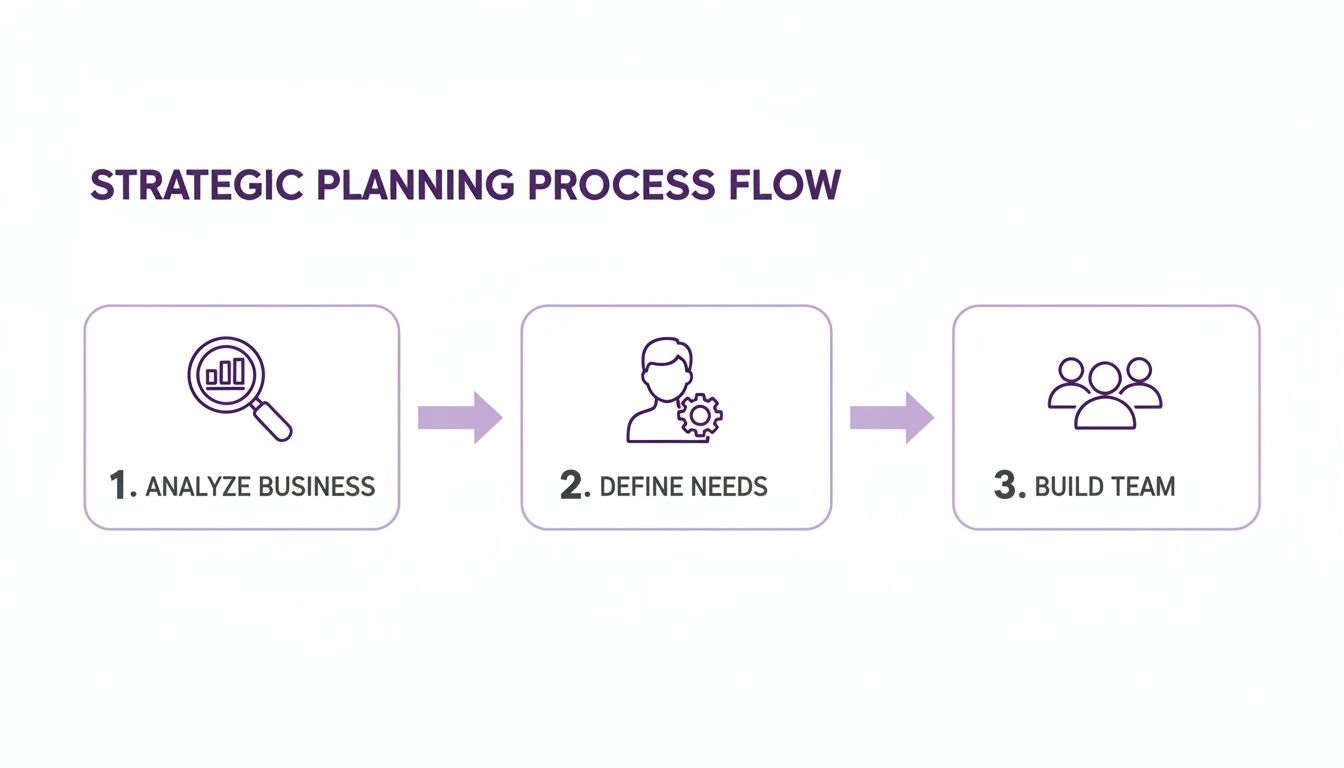
It’s a straightforward loop, forcing you to connect every hiring decision back to your actual strategy. Let's get into it.
This is where you translate your business strategy into a talent shopping list. Sounds fancy, but it’s just asking the right questions. Expanding into a new market? Doubling revenue? Launching a new product that will change the world (or at least your industry)?
Each of those goals has a "people cost." Your job is to quantify it.
Don’t get lost in the weeds. Start with your big goals for the next 18-24 months and work backward. This step is all about defining what you need to win.
Time for an honest look in the mirror. Who’s on the payroll right now? What can they actually do? And, most importantly, who’s about to get poached by a competitor?
This isn't a headcount. It’s a skills inventory. You might find a brilliant junior dev who’s ready for a senior role, or realize that your only DevOps expert has updated their LinkedIn profile to "Open to Work." Ouch.
This is your moment of truth. You’re taking stock of your current talent assets and liabilities. Skipping this is like planning a road trip without checking if your car has gas—you’re not getting very far.
This internal audit tells you what you’re working with before you start writing checks to recruiters.
Here’s where the magic happens. You have your demand (the team you need) and your supply (the team you have). The space between them is your talent gap.
This is the most critical output of your entire exercise. It gives you a crystal-clear, prioritized list of what you need to do. It might show you need:
A vital part of this is performing a comprehensive gap analysis to turn these insights into an action plan. Without it, you’re just guessing.
Finally, you build your plan. This document outlines exactly how you’ll close those gaps. It’s where you decide how, when, and where you’ll get the talent you need. For anyone serious about this, exploring various workforce planning strategies is a non-negotiable step to make sure you’re not picking the wrong tool for the job.
But here’s the pro tip: no plan survives contact with reality. Your funding might get delayed, a competitor could get acquired, or a global pandemic could flip the world upside down.
That’s why you need scenario planning. Don’t just create one plan; build a few.
Thinking through these scenarios forces you to build a more resilient, adaptable talent strategy that won’t shatter at the first sign of trouble.
Let's talk about the two things that keep founders up at night: money and sanity. Spending time on strategic workforce planning can feel like a luxury when you're busy putting out fires. But I’m telling you, it’s one of the highest-leverage things you can do.
This isn’t about tidy spreadsheets. It’s about the tangible, bankable return you get from looking more than five minutes into the future. It’s about de-risking your growth so you don't stall out just as you’re hitting your stride.
Every time you make a reactive hire, you're paying a tax. You pay it in fat recruiter fees for a "unicorn" candidate needed yesterday. You pay it in the opportunity cost of your own time—hours spent sifting through résumés instead of, you know, running the business. Hope you enjoy spending your afternoons fact-checking resumes and running technical interviews—because that’s now your full-time job.
And the most painful part? The cost of a bad hire. When you rush, you compromise. You bring someone on who’s a culture-killer or doesn't have the skills, and six months later you’re right back where you started, only poorer and more frustrated.
Strategic planning flips the script. Instead of paying a premium for last-minute talent, you build a pipeline. You know who you need and when, giving you time to find the right people, not just any person. This foresight alone can save you a fortune.
Beyond hiring, there's the massive risk of not planning for how skills will evolve. As technology like AI and automation reshapes industries, entire jobs are becoming obsolete. The World Economic Forum and other smart people estimate that tens of millions of jobs will be disrupted in the coming years.
Specifically, reports suggest that around 92 million jobs globally may be displaced by tech. This isn't a sci-fi future; it's happening right now. Check out more insights on how automation is reshaping roles via KPMG.
Ignoring this is like running a taxi company in 2015 while pretending Uber doesn't exist. A solid workforce plan forces you to confront these changes, helping you upskill your current team and hire for the capabilities of tomorrow, not yesterday.
Finally, the most underrated ROI is retention. When you plan your workforce strategically, you're not just backfilling roles—you're building career paths. You can actually show your rising stars where they can go within the company, giving them a damn good reason to stick around.
This transforms your team from a line item on a P&L into an appreciating asset.
And when you have gaps you can't fill internally, you can turn to flexible staffing solutions to bridge the divide without taking on the long-term risk of a full-time hire. This gives you the agility to adapt without breaking the bank.
Ultimately, strategic workforce planning is a financial discipline disguised as an HR function. It’s the difference between building a company that lasts and one that's perpetually one bad hire away from disaster.
I’ve seen it a dozen times. Smart founders build these beautiful, color-coded workforce plans that look incredible in a slide deck. Then, the second they hit reality, they completely fall apart. A plan is only as good as its connection to the real world.
Think of this section as your field guide to avoiding the classic blunders. A founder-to-founder warning on how to sidestep the traps that turn a strategic advantage into a pile of useless spreadsheets.
The first pitfall is deceptively logical. You start digging into the data—headcount projections, attrition rates, skills matrices. It feels productive. But soon, you’re drowning in spreadsheets, running endless scenarios, and trying to forecast the future with decimal-point accuracy.
Weeks turn into a month, and you still haven't made a single hiring decision.
The Hard Truth: A "good enough" plan you can act on today is infinitely better than a "perfect" plan you're still debating next quarter. The goal is direction, not precision. Don't let the hunt for flawless data stop you from making a move.
Action beats analysis every single time. Get a working model, not a Nobel Prize in economics.
This one is a classic. Leadership gets together for an offsite, dreams up a brilliant three-year strategy, and builds a workforce plan to match. It’s visionary. And it has zero connection to what your managers on the ground actually need.
Your engineering lead is screaming for two more mid-level devs just to keep the lights on, but the plan says the next hire is a "Synergy Architect."
This is planning in a silo. It happens when you create a strategy without talking to the people who have to execute it. The result? A plan that’s immediately ignored because it’s completely out of touch. Your plan has to solve real problems for the people in the trenches, or it’s just corporate fan fiction.
The single biggest mistake is treating your workforce plan like a sacred text. You spend a month creating it, present it, and then file it away, never to be seen again. You did the "strategy thing," now back to work.
Wrong. Your business changes constantly. Competitors launch new features, key employees quit, markets shift. A plan that was brilliant in January is a historical artifact by June.
Your strategic workforce plan isn't a static document; it’s a living guide. It needs to be revisited, challenged, and updated—at a minimum—every quarter.
Here's how to steer clear of these traps:
Avoiding these pitfalls isn't about having a better process; it's about a better mindset. A workforce plan is a compass, not a map. It gives you a direction, but you still have to navigate the terrain.
Alright, enough theory. Spreadsheets don't ship product. Let's walk through a concrete example I’ve seen play out a dozen times.
Imagine a Series A SaaS startup, let's call them "SyncUp." They've hit product-market fit in the US and their big goal for the next 18 months is to expand into Latin America—Brazil, Mexico, and Colombia.
They could just throw job descriptions on LinkedIn and hope for the best. Or, they can get serious.
First, SyncUp translates "expand into LatAm" into a specific shopping list. After a frank conversation, their initial demand forecast looks like this:
That’s their demand. Clear, specific, and tied directly to the goal.
Next, they look inward. What’s their current supply of talent that meets these needs?
The answer is brutally simple: zero.
Their current team is entirely US-based. No one speaks fluent Portuguese, and their engineers have zero experience with payment gateways in Brazil. The supply analysis takes about five minutes.
This reveals a massive talent gap. The chasm between the team they have and the team they need is stark. This clarity is the entire point—it replaces vague anxiety with a concrete problem to solve.
Now, how do they close the gap? SyncUp’s leadership maps out a few scenarios.
Scenario A: Hire Locally in Each Country
Scenario B: Relocate US Staff
Scenario C: Build a Remote Team from Latin America
The answer becomes obvious. Scenario C is the only one that balances speed, cost, and access to the right skills. But the "how" is the million-dollar question. Turns out there’s more than one way to hire elite developers without mortgaging your office ping-pong table.
This is where you pull a strategic lever. For SyncUp, success isn't just about finding talent; it's about accessing it quickly and compliantly. This is where a partner comes in, not as a desperate last-resort recruiter, but as a core part of the action plan. They provide the infrastructure to tap into that LatAm talent pool without the operational drag.
This is strategic workforce planning in action: a logical path from a big idea to an executable hiring roadmap. The plan also acknowledges a global trend: data shows 85% of employers plan to upskill their existing workforce, while 70% will hire new staff with in-demand skills. SyncUp's plan focuses on the latter. Learn more about these workforce strategy findings from the World Economic Forum.
Let’s be real. The biggest thing holding you back from this isn't how complicated it is. It's the feeling that you need a massive HR department and a six-figure software budget.
You don't. That’s an excuse to kick the can down the road while your competitors build the teams that will eat your lunch.
This is your quick-start guide. No fluff, no jargon—just three steps to create your 'v1.0' workforce plan this quarter. We're aiming for progress, not perfection.
This is about building the muscle of forward-thinking talent management. Starting small is infinitely better than not starting at all. Grab a whiteboard.
1. Lock In Your Goals (The Next 18 Months)
Get your leadership team in a room for two hours. The only agenda item: what are our three most critical business goals for the next 18 months? Launching a new product? Smashing a revenue milestone? Write them down. Make them painfully clear.
2. Have Brutally Honest Conversations
Now, take those goals to your team leads. Ask one simple, terrifying question: "Looking at your current team, what skills or roles are we missing that will absolutely prevent us from hitting these goals?" This is not the time for ego. You need the ground truth.
3. Map It on a Spreadsheet
Create a dead-simple table. Column A: Business Goal. Column B: Required Skills/Roles. Column C: Current Team Member (if any). Column D: The Gap. That's it. This is now the foundation of your talent strategy. It's your North Star for every hiring decision.
This simple exercise forces clarity. It moves you from "we should probably hire another engineer" to "we need a senior backend engineer with AWS experience by Q3 to support the product launch, or the deadline slips." See the difference?
Once you have this map, you have a clear view of your talent gaps. This foresight is what lets you start sourcing candidates before it's an emergency. For a deeper dive, check out our guide on how to build a talent pipeline and get ahead of the curve.
Your first plan will be messy. It’ll probably be wrong in a few places. Who cares? You've already lapped every founder still stuck in the reactive hiring death loop. Now go build the team you actually need.
Alright, let's tackle the questions probably bouncing around in your head. No corporate-speak, just straight answers.
Think of it less like a constitution and more like a battle plan. A major review annually is a good baseline, but you should be giving it a pulse check quarterly.
Did a competitor make a move that changes your roadmap? Did you blow past your Q2 targets? A quarterly check-in keeps the plan from becoming useless office decor. It’s like your budget—you set it annually but review it constantly to make sure you’re not about to drive off a cliff.
Great question. They're related, but they're different beasts.
Succession planning is hyper-focused on risk. It asks, "Who takes over if our CTO quits tomorrow to start a goat farm?" It’s your leadership insurance policy.
Strategic workforce planning is broader. It looks at the entire organization and asks, "What skills, teams, and roles do we need in three years to crush our goals?"
In short: Succession planning is about replacing a few key players. Strategic workforce planning is about building the entire team to win the championship. One is a lifeboat; the other is the blueprint for the ship.
Yes. In fact, it's arguably more critical for a startup, where one bad hire can sink the entire ship. The stakes are higher when you have a crew of 20 instead of 2,000.
This doesn't need to be some complex, data-heavy process.
It can be as simple as the leadership team, a whiteboard, and a dedicated half-day to map out the next 12-18 months. It's about instilling the discipline of thinking ahead—a massive advantage when your competitors are just reacting to yesterday's fires.

